EMDR Consultation for Certification: How the 20 Hours Work and How to Find a Group

EMDR consultation is where most clinicians actually learn EMDR. Basic training gives you the eight phases, the standard protocol and a few practicum hours. But the work only gets real once you sit across from a client whose processing loops for twenty minutes, or who can't name a single target, or who dissociates halfway through a set. Consultation is where you bring those moments and learn what to do with them.
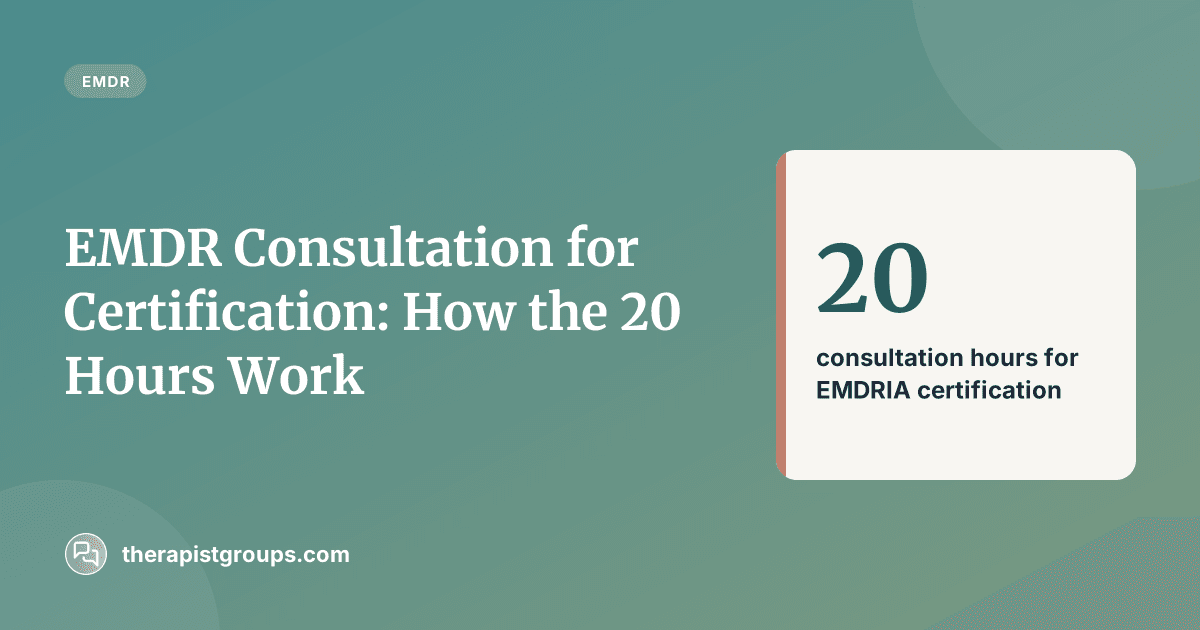
If you are pursuing EMDRIA certification, EMDR consultation is also a formal requirement: 20 hours, with specific rules about who provides them and how many can happen in a group. This guide explains how those hours work, what an EMDR consultation group can and can't count toward, what consultation typically costs, and how to choose a consultant you'll genuinely learn from.
What EMDR consultation is (and why clinicians keep doing it)
EMDR consultation is case-focused guidance from an experienced EMDR clinician, usually an EMDRIA Approved Consultant, after you've completed basic training. It isn't a second training and it isn't supervision. You stay fully responsible for your clients, and the consultant helps you think more clearly about them.
In practice, much of the time goes to case conceptualization and readiness. Is this client stable enough to begin reprocessing, or do they need more preparation and resourcing first? New EMDR clinicians often err in one of two directions. Some move into Phase 4 too early with clients who have complex trauma histories. Others stay in preparation for months because they're anxious about opening something they can't close. A good consultant helps you calibrate.
Target selection is the other recurring theme. Building a target sequence, choosing the touchstone memory, and knowing when a "small" target is actually a door into something much larger are judgment calls that only develop with practice and feedback. So is the moment-to-moment work of stuck processing: recognizing looping, deciding whether to use a cognitive interweave, and managing abreactions or dissociation without abandoning the protocol.
Many clinicians finish their certification hours and keep consulting anyway. An ongoing EMDR consultation group becomes a standing place to think through hard cases with colleagues who use the same model and speak the same language. For clinicians in solo private practice, that continuity is often the most valuable part.
EMDRIA certification requirements at a glance
Consultation is one requirement among several. As of this writing, EMDRIA lists the following for the EMDRIA Certified Therapist credential:
| Requirement | What EMDRIA asks for |
|---|---|
| Basic training | An EMDRIA-approved EMDR Basic Training, completed in full |
| Consultation | 20 hours from EMDRIA Approved Consultants (details below) |
| Clinical experience | At least 50 EMDR sessions with at least 25 clients |
| Licensure | A current license to practice independently, and at least 2 years of experience in your field |
| Continuing education | At least 12 EMDRIA credit hours completed after basic training |
| Recommendations | One letter from an Approved Consultant and two from colleagues |
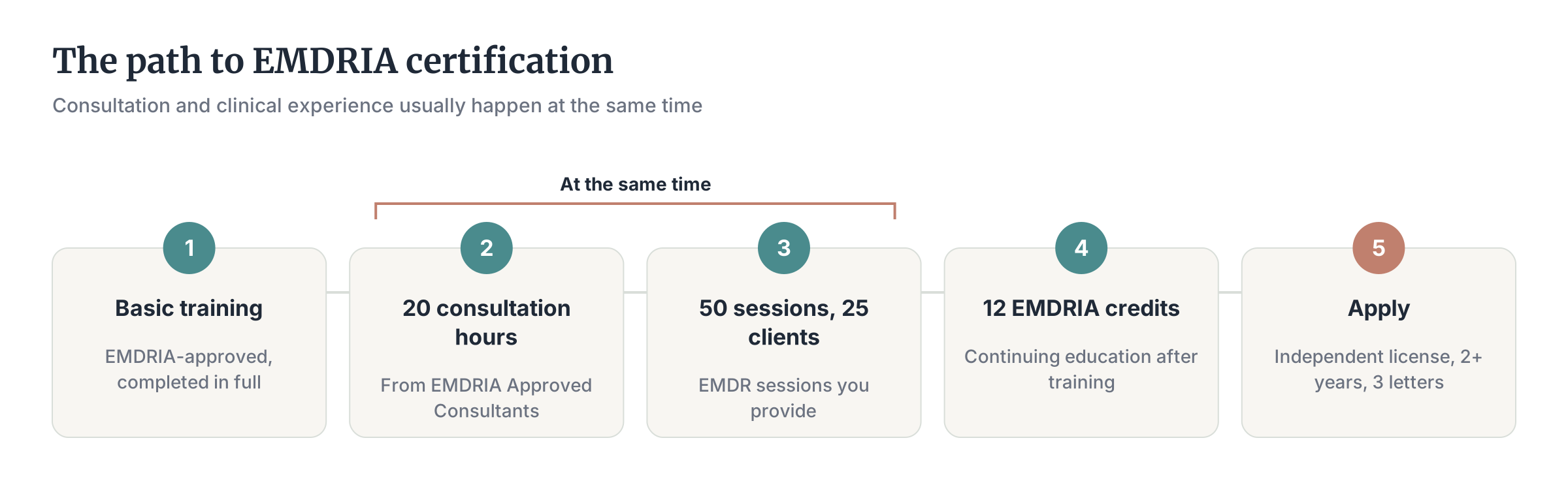
These steps don't happen strictly in order. Most clinicians build their consultation hours and their 50 sessions in parallel, because consultation is most useful while you're actively seeing EMDR clients. The continuing education credits can be earned along the way. Requirements are updated from time to time, so check EMDRIA's current version before you plan your hours.
How the 20 EMDR consultation hours break down
The 20 hours aren't interchangeable. Two separate rules apply at the same time: one about format (individual or group) and one about who provides the consultation.
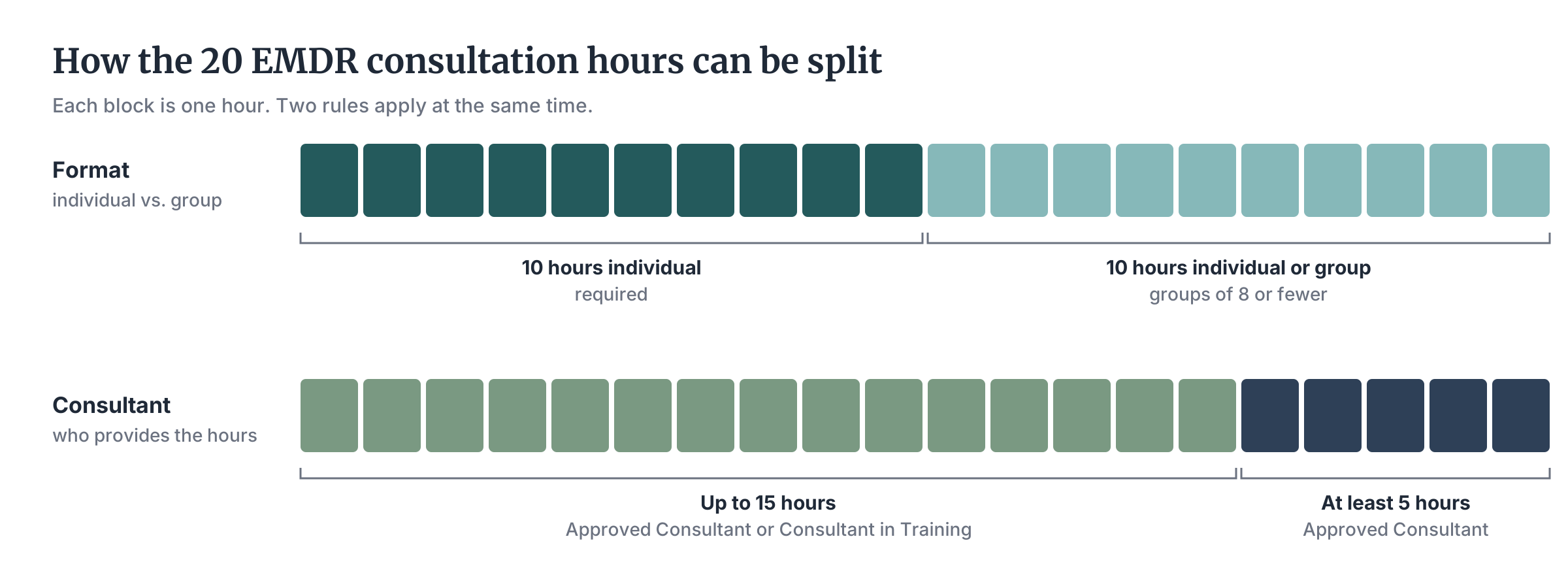
Individual vs. group EMDR consultation hours
At least 10 of the 20 hours must be individual consultation. The remaining 10 can be individual, group, or any mix of the two. EMDRIA caps group consultation at a 1:8 ratio, so a qualifying group has no more than eight participants per consultant.
That makes an EMDR consultation group a natural fit for the flexible half of the requirement. It is usually the more affordable half, too, and the group setting has learning advantages of its own, covered below.
Approved Consultants vs. Consultants in Training
All hours must come from EMDRIA's consultant pathway, with one useful allowance: up to 15 hours can come from Approved Consultants in Training, as long as at least 5 come from a fully Approved Consultant. Consultants in Training are experienced EMDR clinicians who are themselves working toward consultant status, often under supervision. They frequently charge less, which can meaningfully lower the total cost of certification.
The timing rules
Two timing rules trip people up. Consultation hours must be received after you complete basic training, so hours logged while you were still finishing training won't count. And they must fall within the five years before your application. If you started consulting years ago and paused, some of those early hours may have expired by the time you apply.
Is an EMDR consultation group worth it?
For most clinicians, yes, at least for the group-eligible half of the hours.
The most obvious reason is cost. A consultant's time is shared across several clinicians, so the price per session is usually well below individual rates. The less obvious reason is that you learn from cases you would never see in your own practice. Hearing a colleague work through a stuck first-responder case, or a client whose dissociation looks nothing like your caseload, widens your clinical range faster than your own clients alone ever could. Many clinicians say they learned as much from listening as from presenting.
A standing group also builds consistency. Without one, it's easy to consult only when a case goes sideways. With one, you bring smaller questions earlier, before they become big ones.
The trade-off is airtime. In a group of eight, you won't present every session, and the discussion will sometimes wander away from your immediate concerns. If you need focused help with a specific high-risk client, an individual hour is often the better tool, and many clinicians mix both formats for exactly this reason.
What EMDR consultation groups cost
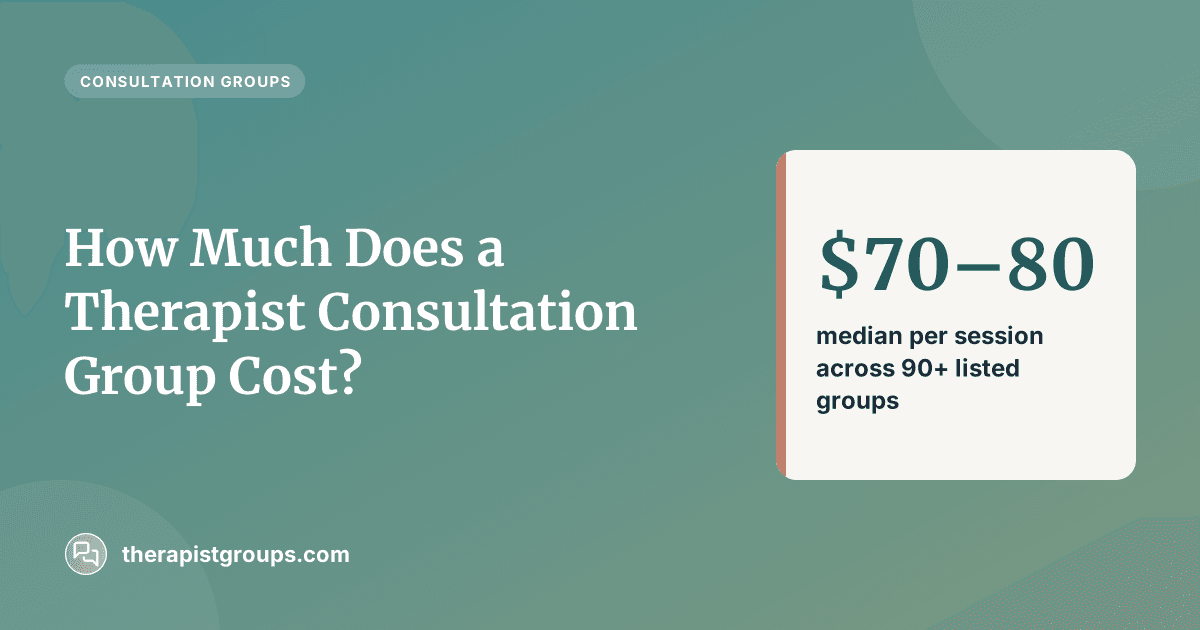
Across the 16 EMDR consultation groups listed on Therapist Groups in October 2026, prices ranged from $50 to $150 per session, with a median of about $70 among the 15 groups that list a price. Half of them (8 groups) meet monthly, with 6 meeting biweekly and 2 weekly.
Because most groups meet monthly, a typical EMDR consultation group costs roughly $70 a month. For a broader look at pricing across specialties, see how much therapist consultation groups cost.
How to choose an EMDR consultation group
A good consultant matters more than a convenient time slot. It's worth a short call or email before you commit, and a good consultant will welcome the questions.
Questions to ask an EMDR consultant
Start with credentials, because they determine how your hours count. Ask whether the consultant is an EMDRIA Approved Consultant or a Consultant in Training, and how they document hours. You'll need verification of your hours and, eventually, a recommendation letter from an Approved Consultant, so it helps to know early who will provide it.
Then ask about the group itself. How many members are there, and how is time divided? Some groups rotate formal case presentations, so you know when your turn is coming. Others are open discussion, where whoever has the most pressing case goes first. Neither is better, but they suit different people. Smaller groups give you more time to present (and qualifying groups must stay at eight or fewer).
Finally, ask about clinical focus. Consultants have specialties. If your caseload leans toward complex trauma and dissociation, children and adolescents, perinatal clients, or first responders, a consultant who knows that population will give you far more useful feedback than a generalist.
Signs a group is a good fit
The best fits tend to show themselves quickly. A consultant who asks about your caseload and goals before you join is usually one who will tailor the consultation to you. Members at a similar stage make it easier to speak up, while a deliberately mixed-level group can be equally good if it is run with that in mind. And practically, choose a meeting time you can keep for months, not weeks. Consultation compounds when it is consistent.
You can compare EMDR groups by schedule, price and focus on our EMDR consultation groups page, which updates as new groups are listed.
A realistic plan for finishing your EMDR consultation hours
Most clinicians who finish efficiently combine formats. They start with individual consultation while building confidence with early cases, which also chips away at the 10 required individual hours when focused attention matters most. Once the basics feel steadier, they join an EMDR consultation group for the flexible 10 hours. They ask the consultant up front how attended group time is credited, so there are no surprises at application time.
Throughout, they track sessions and clients from day one. The 50-session, 25-client requirement is usually what takes longest, and reconstructing it later from old notes is tedious. A simple spreadsheet with date, client initials and session number is enough.
EMDR consultation FAQ
Can all 20 EMDR consultation hours be in a group?
No. At least 10 hours must be individual. Group consultation can make up the other 10.
Do consultation hours from before basic training count?
No. EMDRIA requires consultation hours to be received after you complete an EMDRIA-approved basic training.
Can I do EMDR consultation online?
Yes. Many EMDR consultation groups now meet entirely by video, which widens your choice of consultants well beyond your local area. Most groups listed on Therapist Groups meet online.
Do I need consultation if I'm not pursuing certification?
It isn't required, but many clinicians keep consulting after training because EMDR with complex clients is hard to do well alone.
Sources
Browse 16 EMDR groups
Compare schedules, cost and focus, then contact the group leader directly.
See EMDR groups