Clinical Consultation vs. Supervision: What’s the Difference for Therapists?

Therapists use the two words almost interchangeably, but consultation vs. supervision is a real distinction with practical consequences. It determines who is responsible for your clients, whether you are being evaluated, and whether the hours you spend count toward your license. Mixing them up is common, especially in the first few years after graduate school, and it can lead to paying for a group that doesn't give you what you actually need.
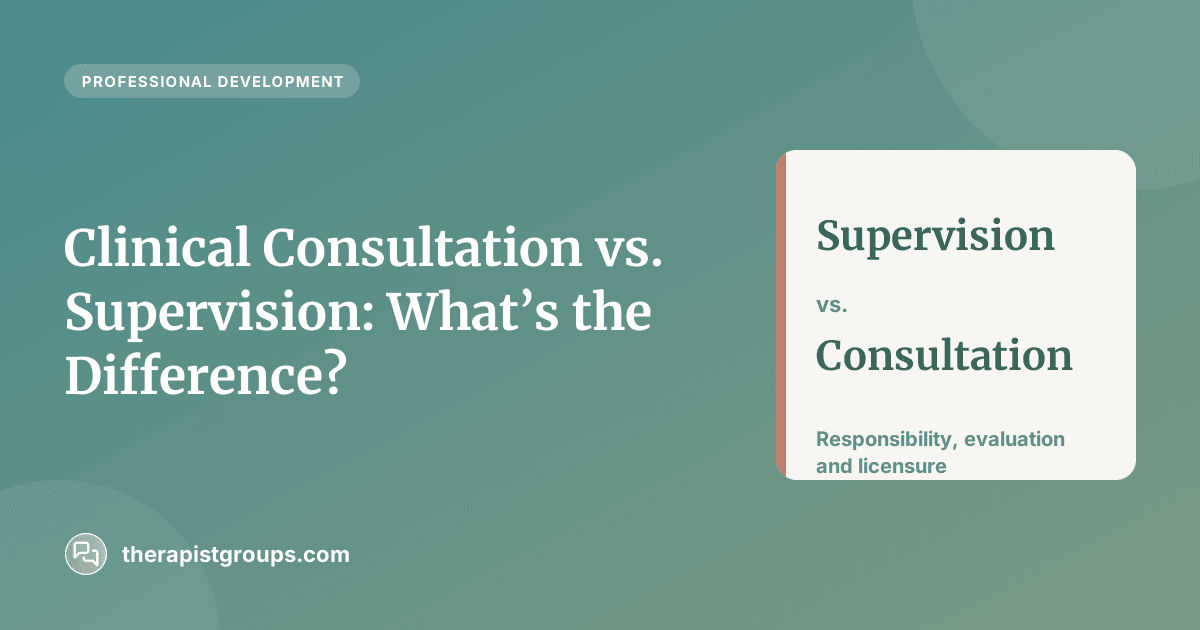
The short version: clinical supervision is an evaluative relationship in which the supervisor shares professional responsibility for your work, and it is usually required. Clinical consultation is a collegial relationship in which you keep full responsibility and decide what to do with the advice, and it is usually voluntary. The rest of this article unpacks what that means day to day.
Consultation vs. supervision at a glance
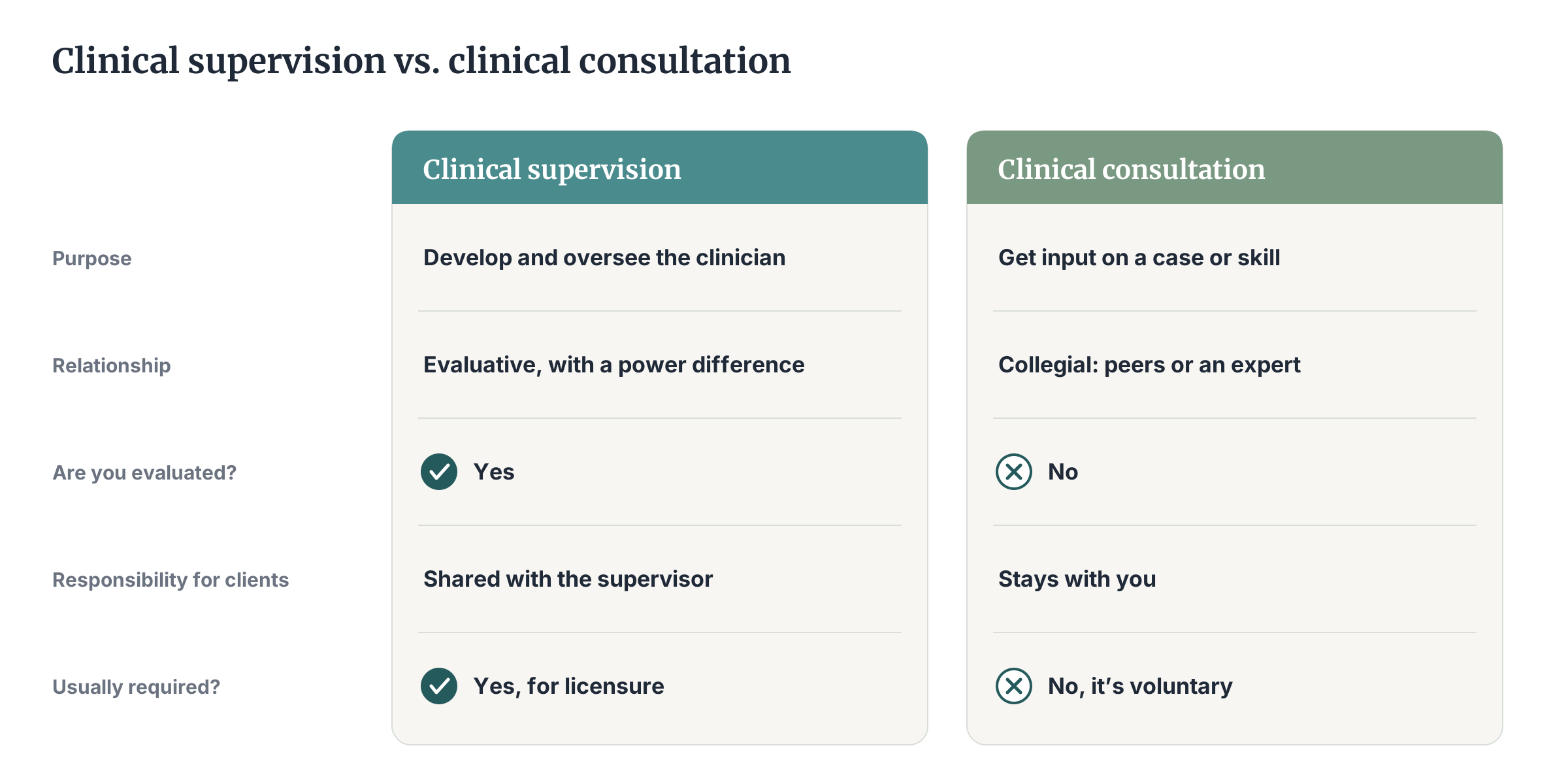
| Clinical supervision | Clinical consultation | |
|---|---|---|
| Main purpose | Develop the supervisee, protect clients, and gatekeep entry to the profession | Get input on a case or a skill |
| Relationship | Evaluative, with a power difference | Collegial, between peers or with an expert |
| Evaluation | Yes. The supervisor assesses your competence | No. The consultant doesn't evaluate you |
| Responsibility for clients | Shared. The supervisor holds professional responsibility | Yours alone. You decide whether to act on advice |
| Usually required? | Yes, for licensure and in many agency roles | No, but widely recommended |
| Common formats | Individual or group supervision | Individual consultation, expert-led groups, peer consultation groups |
What clinical supervision is
The American Psychological Association describes clinical supervision as a collaborative relationship with both facilitative and evaluative components, one that also serves a gatekeeping function for entry into the profession. That last phrase is the heart of it. Supervision exists not only to help you grow, but to make sure that people entering the field can practice safely and competently before they practice alone.
Supervision is evaluative
A supervisor assesses your competence, gives formal feedback, and in many cases signs off on whether you're ready for independent practice. That evaluative role shapes the whole relationship. Even with a warm, supportive supervisor, you are aware that this person's judgment affects your licensure and career. Good supervisors acknowledge that power difference openly rather than pretending it isn't there, and much of the craft of supervision lies in creating enough safety for supervisees to bring their mistakes anyway.
Supervision carries shared responsibility
Because a supervisor oversees your work, they take on professional responsibility, and often liability, for the care your clients receive. That's why supervisors typically need to know about your caseload, may review your documentation, and have the authority to direct changes to treatment. It's also one reason supervision often costs a bit more than consultation: the supervisor is accepting real risk, not just offering an opinion.
Supervision for licensure
For pre-licensed clinicians, supervision is a formal licensing requirement. This includes associate counselors, LMSWs working toward clinical licensure, MFT associates, and others. State boards set the rules: how many hours, over what period, how many can be completed in a group, whether virtual supervision counts, and who qualifies to supervise. Many boards allow part of the requirement to be met through group supervision, which spreads the supervisor's time across several supervisees and is often a more affordable way to accumulate hours alongside individual supervision.
What clinical consultation is
Clinical consultation is input you seek from a colleague or expert about a case, a technique, or a professional question. The APA guidelines draw the line clearly. In consultation, the consultant doesn't evaluate the clinician or carry responsibility for the case, and the clinician decides whether to act on the advice. You might take every suggestion, some of them, or none. The decision, and the responsibility, remain yours.
Expert-led consultation
Many licensed therapists pay for consultation from a specialist. That might be an EMDRIA Approved Consultant, an IFS Approved Clinical Consultant, or a senior clinician in an area like eating disorders or perinatal mental health. This kind of consultation sits in an interesting middle ground. It doesn't count toward licensure, but some of it counts toward modality certifications: both EMDR and IFS certification require documented consultation hours from approved consultants. It is still consultation, though. The consultant doesn't take on responsibility for your clients.
Peer consultation groups
A peer consultation group is a small group of licensed clinicians who meet regularly to present cases and support one another, often without a designated leader or fee. These groups are one of the most common ways therapists in private practice stay connected after leaving agency settings, where supervision and team meetings once provided that structure automatically. A good peer group offers honest feedback, a place to think out loud about difficult cases, and a reminder that the struggles of clinical work are shared.
The key differences between consultation and supervision
Who is responsible for the client
This is the single most important difference. In supervision, responsibility is shared with the supervisor. In consultation, it stays entirely with you. That distinction explains most of the others: why a consultant can't direct your treatment, why consultation hours rarely satisfy licensing requirements, and why supervisors need far more information about your caseload than consultants do.
Whether you are evaluated
Supervision includes formal evaluation. Consultation doesn't. Paradoxically, the absence of evaluation is what makes consultation valuable to many experienced clinicians. It is a lower-stakes space to say "I don't know what I'm doing with this client," or "I'm frustrated with this person and I don't like what that says about me." Those admissions are where some of the most important clinical learning happens.
Who sets the agenda
In supervision, the supervisor has the authority to raise concerns and require changes, including about cases you didn't bring up. In consultation, you bring the questions and choose what to do with the answers. A consultant might strongly recommend something, but the recommendation carries weight only because you choose to give it weight.
Which do you need: a supervision group or a consultation group?
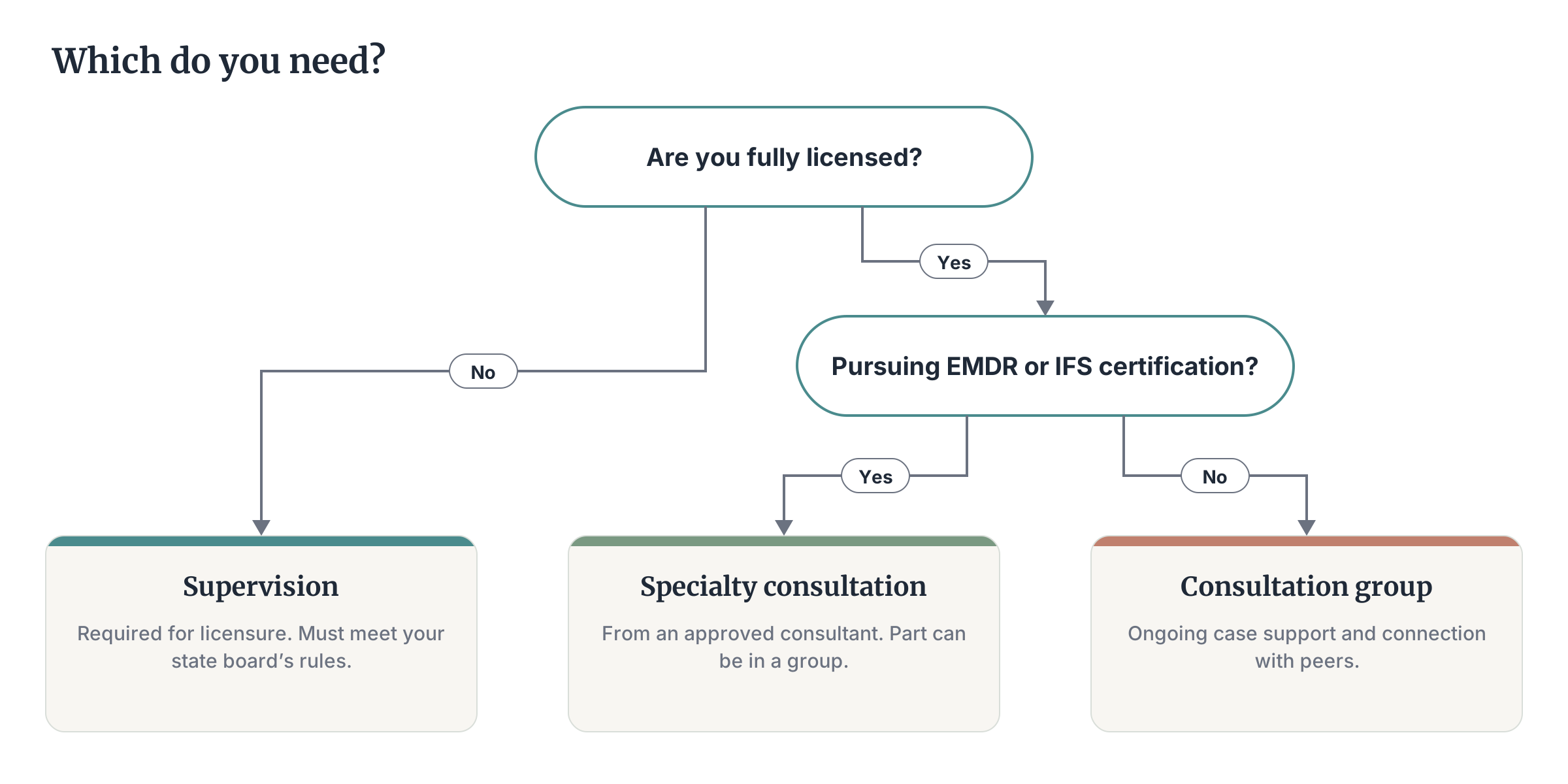
If you're pre-licensed, you need supervision that meets your state board's rules, and no amount of consultation will substitute for it. A clinical supervision group can cover part of your hours if your board allows group supervision, but confirm the supervisor's credentials and how hours will be documented before you join.
If you're licensed and pursuing a modality certification, such as EMDR or IFS, you need consultation from an approved consultant in that model. Part of it can usually happen in a group. See current EMDR consultation groups and IFS consultation groups.
If you're licensed and simply want ongoing case support and connection, a specialty or peer consultation group is the usual answer. Many therapists choose groups organized around their clinical focus. Trauma consultation groups are among the most common.
What group supervision and consultation cost
On Therapist Groups in October 2026, the 21 supervision and licensure groups listed ranged from $25 to $100 per session, with a median of $80 among those listing a price. Most meet biweekly (11 groups) or weekly (9), reflecting the steady pace of licensure requirements. Consultation groups more often meet monthly. See what therapist consultation groups cost for a full breakdown by specialty.
Consultation vs. supervision FAQ
Do consultation hours count toward licensure?
Generally no. Licensure hours have to come from supervision with a supervisor who meets your board's requirements. Check your state board's rules for your specific license.
Can a group be both supervision and consultation?
Group names are used loosely, so it's worth asking. A group described as "supervision" for licensed clinicians may really function as consultation. If you need hours for licensure, confirm the leader's supervisor credentials and how hours are documented before you join.
Do licensed therapists need consultation?
It isn't usually required, but it's widely recommended, especially for complex cases, when using a new modality, or when working alone in private practice.
Is consultation confidential?
Consultation should protect client confidentiality, typically by sharing only the de-identified information needed to get useful input. Follow your profession's ethics code and your state's rules.
Sources
Browse 21 Supervision & licensure groups
Compare schedules, cost and focus, then contact the group leader directly.
See Supervision & licensure groups